

Law Enforcement Software Market to Grow at 8.72% CAGR, Anticipated to Reach USD 47.82 Billion by 2035
Law Enforcement Software Market
Law Enforcement Software Market grows with AI, cloud adoption, enhancing policing, data management, and real-time crime analysis.
Law Enforcement Software Market is transforming modern policing through AI-driven analytics, real-time data sharing, and digital case management systems.”
BERLIN, BERLIN, GERMANY, June 25, 2026 /EINPresswire.com/ -- The global Law Enforcement Software Market is undergoing a significant transformation driven by the convergence of advanced technologies such as artificial intelligence (AI), machine learning, cloud computing, and big data analytics. Governments and law enforcement agencies worldwide are increasingly investing in digital infrastructure to improve public safety, operational efficiency, and crime prevention capabilities. These software solutions encompass a broad range of applications including records management systems (RMS), computer-aided dispatch (CAD), crime analytics, body-worn camera management, evidence management, and jail management systems. — Market Research Future
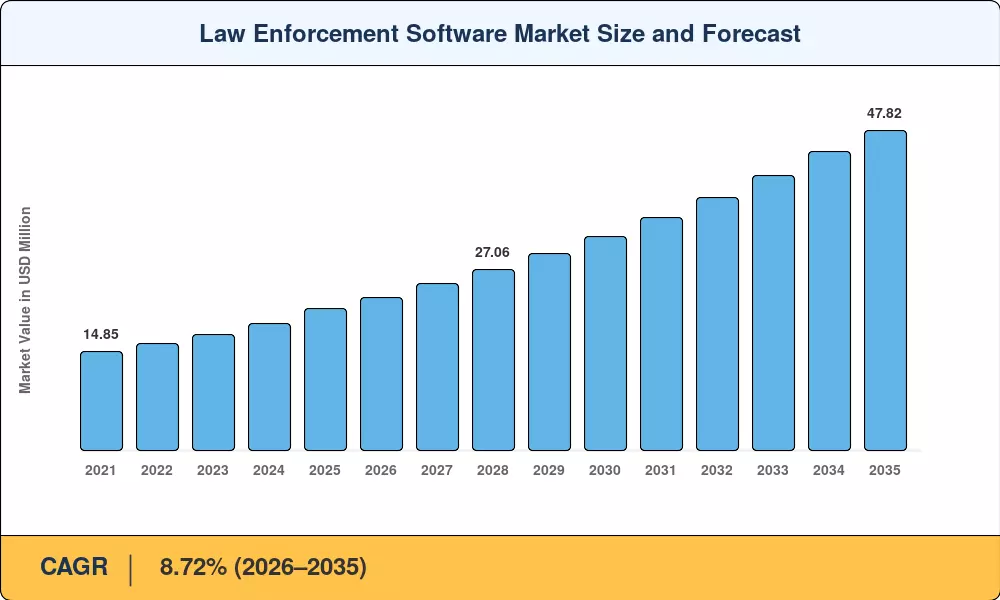
The growing need for real-time data processing, seamless inter-agency communication, and accountability in policing has accelerated the adoption of sophisticated software platforms across police departments, correctional facilities, and federal agencies globally. Law Enforcement Software Market stood at an estimated USD 21.17 Billion in 2025, with the forecast period opening at USD 22.89 Billion in 2026 and climbing to USD 47.82 Billion by 2035 at an 8.72% CAGR.
Leading Industry Participants
The law enforcement software market is highly competitive, featuring a mix of established technology conglomerates, specialized public safety vendors, and innovative startups. These players continuously invest in R&D and strategic partnerships to enhance their product portfolios and expand their global reach. The key leading participants shaping this market include:
• Motorola Solutions, Inc.
• Tyler Technologies, Inc.
• Axon Enterprise, Inc.
• IBM Corporation
• Palantir Technologies Inc.
• Oracle Corporation
• Hexagon AB
• CentralSquare Technologies
• Mark43, Inc.
• Verint Systems Inc.
• PTC Inc. (Pure Safety Group)
• Spillman Technologies (Motorola)
• Forensic Technology (FARO Technologies)
Click Here to Get Sample Premium Report - https://www.marketresearchfuture.com/sample_request/6440
Key Growth Factors
Several macroeconomic and technological forces are propelling the law enforcement software market forward. The rapid urbanization of global populations has led to rising crime rates in metropolitan areas, prompting municipal governments to modernize their policing infrastructure. The proliferation of IoT-enabled devices, smart surveillance cameras, and connected sensors is generating unprecedented volumes of data that require robust software platforms for analysis and actionable intelligence.
Additionally, mounting pressure from the public and regulatory bodies for greater transparency and accountability in policing has spurred investments in body-worn camera systems and evidence management solutions. Cloud migration trends are enabling law enforcement agencies to access scalable, cost-effective software without heavy upfront infrastructure investments. Government stimulus packages and homeland security budgets across North America and Europe are further fueling market expansion, as agencies seek to upgrade legacy systems and adopt next-generation digital tools to combat evolving threats including cybercrime, terrorism, and organized crime.
Emerging Growth Opportunities
The law enforcement software landscape is rich with emerging opportunities that vendors and investors are actively exploring. Predictive policing and crime forecasting tools powered by AI and machine learning represent one of the most promising frontiers, enabling agencies to pre-emptively allocate resources and prevent criminal activity before it occurs. The integration of facial recognition technology, license plate recognition (LPR), and biometric identification systems within law enforcement platforms is creating substantial new revenue streams. The adoption of cloud-native and Software-as-a-Service (SaaS) models is opening the market to smaller municipalities and developing nations that previously lacked the capital for on-premise deployments.
Furthermore, the growing emphasis on mental health crisis intervention and community-oriented policing is creating demand for specialized software that helps officers navigate complex social situations. As smart city initiatives proliferate globally, law enforcement software is being tightly integrated with urban management platforms, creating holistic ecosystems that enhance both safety and quality of life. The Asia-Pacific region, in particular, offers vast untapped potential as countries like India, Indonesia, and Vietnam scale up their digital law enforcement infrastructure.
Key Market Barriers & Challenges
Despite strong growth tailwinds, the law enforcement software market faces several formidable challenges. Privacy and civil liberties concerns remain one of the most contentious barriers, particularly around the use of facial recognition, mass surveillance, and predictive policing technologies. Public advocacy groups and legislators in many jurisdictions have moved to restrict or ban certain tools, creating regulatory uncertainty for vendors. Budget constraints within government agencies, especially in developing economies, limit the pace of technology adoption and often result in prolonged procurement cycles. The complexity of integrating new software with decades-old legacy systems poses significant technical and operational hurdles, requiring substantial customization and migration efforts.
Cybersecurity threats are also a critical concern, as law enforcement databases contain highly sensitive data that are prime targets for hackers and state-sponsored actors. Additionally, insufficient training and change management support within agencies often leads to suboptimal utilization of sophisticated platforms, undermining return on investment. Addressing these challenges requires a collaborative approach among vendors, governments, civil society, and academia to establish ethical standards, robust data governance frameworks, and equitable access to technology.
Segment-wise Market Breakdown
The law enforcement software market can be segmented across several dimensions to provide a comprehensive view of its structure and growth vectors. Understanding these segments is critical for stakeholders aiming to identify high-value investment and partnership opportunities:
By Component:
• Software Solutions
• Services (Professional Services, Managed Services)
By Deployment Mode:
• Cloud-Based
• On-Premise
• Hybrid
By Application:
• Records Management System (RMS)
• Computer-Aided Dispatch (CAD)
• Evidence Management
• Jail Management System (JMS)
• Crime Analytics & Intelligence
• Body-Worn Camera Management
• Others
By End-User:
• Police Departments
• Correctional Facilities
• Federal & Government Agencies
• Border Control & Customs
• Judiciary & Courts
By Organization Size:
• Large Enterprises
• Small & Medium Enterprises (SMEs)
By Technology:
• Artificial Intelligence & Machine Learning
• Cloud Computing
• IoT & Sensor Integration
• Biometrics & Facial Recognition
• Blockchain for Evidence Chain of Custody
Browse Full Report Details - https://www.marketresearchfuture.com/reports/law-enforcement-software-market-6440
Geographical Market Insights
North America dominates the global law enforcement software market, accounting for the largest revenue share due to the region's well-established public safety infrastructure, high technology adoption rates, and substantial government spending on homeland security. The United States, in particular, drives significant demand through federal programs such as the FBI's Next Generation Identification (NGI) system and the Department of Homeland Security's various digital initiatives. Europe holds the second-largest market share, propelled by the European Union's investment in cross-border law enforcement cooperation platforms and the growing adoption of body-worn cameras across the UK, Germany, France, and the Netherlands. However, the region is also subject to stringent data protection regulations under GDPR, which influence software design and deployment practices.
The Asia-Pacific region is poised to register the fastest growth rate over the forecast period, driven by rapid urbanization, rising crime and terrorism concerns, and significant government investments in smart city projects across China, India, Japan, South Korea, and Australia. Latin America and the Middle East & Africa are also emerging as important markets, with nations like Brazil, Mexico, Saudi Arabia, and the UAE investing heavily in modernizing their law enforcement ecosystems to combat escalating security challenges and support economic development goals.
Frequently Asked Questions (FAQs)
1. What is law enforcement software?
Law enforcement software is a digital solution used by police departments and security agencies to manage investigations, records, case management, reporting, and real-time operations efficiently.
2. What are the key applications of law enforcement software?
It is commonly used for crime data management, incident reporting, evidence tracking, dispatch management, digital forensics, and predictive policing.
3. What factors are driving the growth of this sector?
Rising crime rates, increasing demand for digital transformation in public safety, adoption of AI-based analytics, and the need for efficient data management are major growth drivers.
4. Which technologies are commonly integrated into law enforcement software?
Technologies include artificial intelligence (AI), cloud computing, machine learning, data analytics, facial recognition, and geographic information systems (GIS).
5. Who are the primary end users of law enforcement software?
Police departments, federal agencies, homeland security organizations, intelligence units, and correctional facilities are the primary users.
6. What are the benefits of using law enforcement software?
It improves operational efficiency, enhances crime-solving speed, enables better data sharing, reduces manual paperwork, and supports real-time decision-making.
7. What challenges does the market face?
Data privacy concerns, high implementation costs, cybersecurity risks, and integration issues with legacy systems are key challenges.
8. Is cloud-based deployment popular in this sector?
Yes, cloud-based solutions are increasingly popular due to scalability, remote access, cost-effectiveness, and easier data sharing.
9. How does AI impact law enforcement software?
AI helps in predictive policing, crime pattern analysis, facial recognition, automated reporting, and faster investigation processes.
10. What is the future outlook of this sector?
The sector is expected to grow steadily with increased adoption of smart policing tools, IoT integration, and advanced analytics for public safety.
➤➤Discover Market Trends Through Detailed Country-Wise and Regional Reports for the Main Keyword.
China Law Enforcement Software Market -
https://www.marketresearchfuture.com/reports/china-law-enforcement-software-market-60734
India Law Enforcement Software Market -
https://www.marketresearchfuture.com/reports/india-law-enforcement-software-market-60906
Japan Law Enforcement Software Market -
https://www.marketresearchfuture.com/reports/japan-law-enforcement-software-market-60733
Us Law Enforcement Software Market -
https://www.marketresearchfuture.com/reports/us-law-enforcement-software-market-15383
➤➤ Market Research Future's Regional Market Analysis:
Asia Pacific Data Center Market-
https://www.marketresearchfuture.com/reports/asia-pacific-data-center-market-21604
Philippine Ict Market-
https://www.marketresearchfuture.com/reports/philippine-ict-market-21618
Europe Simulation Software Market-
https://www.marketresearchfuture.com/reports/eu-simulation-software-market-21755
Iot And Digital Transformation Market-
https://www.marketresearchfuture.com/reports/iot-digital-transformation-market-21863
Risk Assessment And Management Market-
https://www.marketresearchfuture.com/reports/risk-assessment-and-management-market-21896
Hosted Pbx Market-
https://www.marketresearchfuture.com/reports/hosted-pbx-market-21933
Sagar Kadam
Market Research Future
+ +1 628-258-0071
email us here
Legal Disclaimer:
EIN Presswire provides this news content "as is" without warranty of any kind. We do not accept any responsibility or liability for the accuracy, content, images, videos, licenses, completeness, legality, or reliability of the information contained in this article. If you have any complaints or copyright issues related to this article, kindly contact the author above.
